|
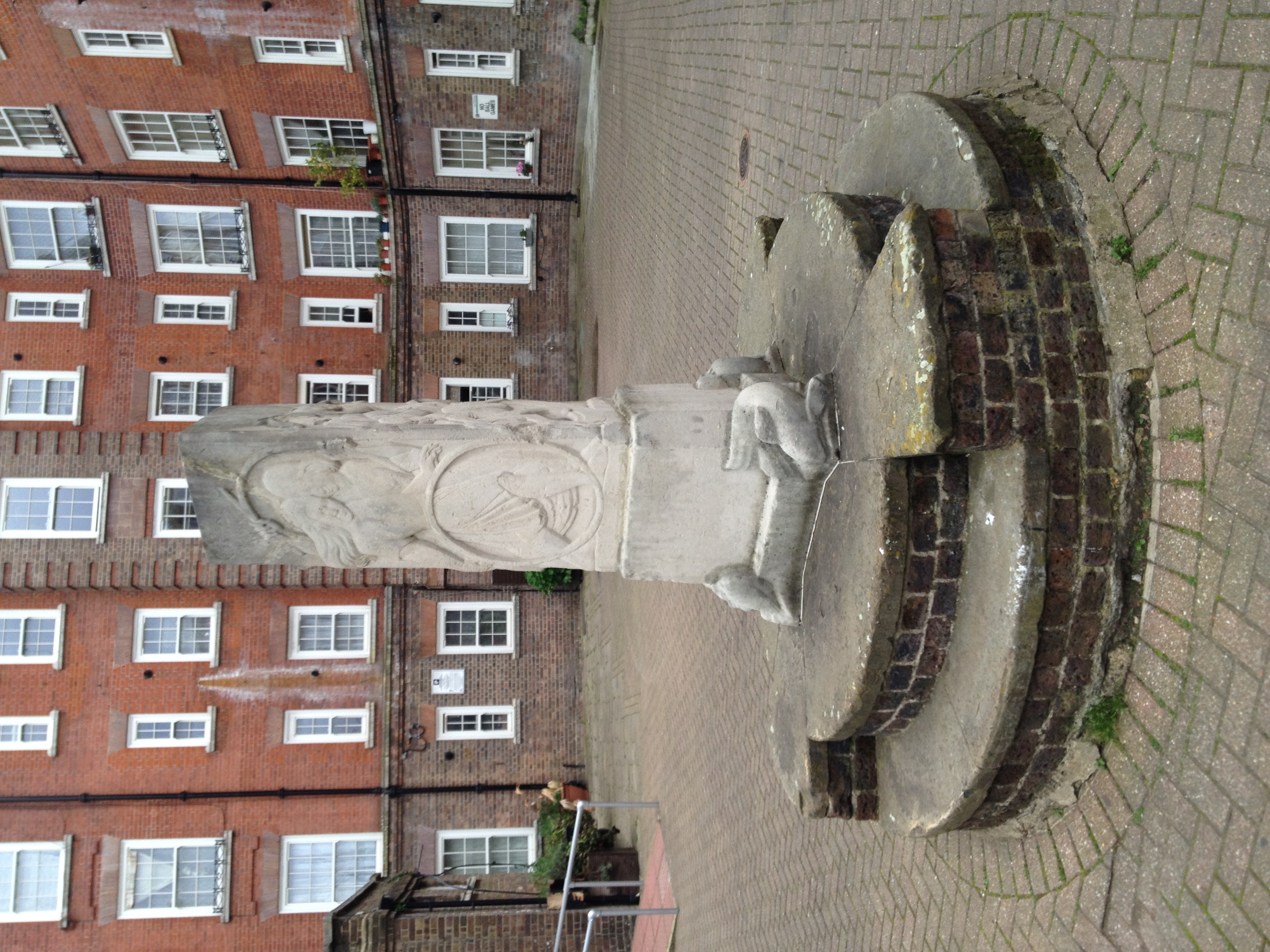
Walden House
Credit Danrok, CC BY-SA 4.0 , via Wikimedia Commons
|
Whilst I don't know whether the campaign to save Walden House and the associated Cundy Street development that I referred to in my last post in this blog has been successful or not - I fear that Covid has not helped the situation - I have discovered the report of the opening of this building in the Chelsea News and General Advertiser of 23 May 1924 which has been digitised by the British Newspaper Archive
As this is now of historical importance, and potentially useful to the Save Cundy Street and Walden House campaign, as well as being important in my own family history research I have transcribed the full report below.
FORTY NEW FLATS. OPENING OF 'WALDEN' BUILDINGS.
Mr. Wheatley, the Minister of Health, opened on Monday afternoon the City of Westminster Dwellings, which have been erected in Pimlico-road on land given by the Duke of Westminster. The building, which is five stories in height, is faced with red Leicester wire cut bricks and brown Crowborough facing bricks to relieve the monotony. The arches are of tiles, and the entrance doorways are finished with glazed facing bricks to avoid damage. The staircase walls are lined throughout with tiles to ensure an absolutely smooth and clean surface, requiring no annual expense for distempering. The balusters are of an ornamental character. The floors and roof throughout are of fireproof construction, and the pavings and landings, sculleries, and bathrooms are finished with granolithic. The sculleries, bathrooms, etc., are all tiled to a height of five feet with white glazed tiles, finished with a band of red tiles. The building comprises 15 three-room flats, 20 four-room fiats, and 5 five-room flats, a total of 40 flats, containing 150 rooms, capable of housing approximately 300 persons. All the fiats are absolutely self contained, and lighted by gas on the slot system. The rents of the building are: For a five-room flat 17s. 6d. per week plus rates four-room flat, 14s. plus rates three-room flat 10s. 6d. plus rates. To meet the express wish of the donor of the site, only those persons with children living with them are to be accepted as tenants. Every flat is occupied. The building has taken a year to erect.
THE OPENING CEREMONY.
The Mayor of Westminster (Councillor Edgar Horne). presided at the opening ceremony, and among others present were Lord Jessel, Mr. J. M. Erskine, M.P., Alderman and the Hon. Mrs. G. W. Tallents, Mr. Detmar Blow (representing the Duke of Westminster), the Rev. Jocelyn Perkins, Rev. R. A. Mitchell, Alderman and Mrs. Lawrence, Councillor Mrs. Ridley Smith, Dr. F. J. Allan (Medical Officer of Health), General Cooper, LC.C., Miss Gascoigne, Mr. C. S. Joseph. the architect. Mr. J. Cameron (Higgs and Hill, Ltd., contractors), Lady Bradford, Canon H. L. C. de Candole, and the following members of the Housing Committee of the Westminster City Council :—The Rev. E St. George Schomberg (Chairman), Alderman Sir Robert Walden (Vice-Chairman), Councillors Vice-Admiral Sir Henry H. Bruce, Mr. S. P. B. Bucknill, G. Booth Heming, Major W. C. Hussey, Miss A. M. Mercer, Mrs. F. M. Odone, Major R. Rigg, C. L. Roberson, and Leopold C. Stewart.
FINANCIAL DIFFICULTIES.
Councillor the Rev. E. St. George Schomberg said that the Housing Committee were aware that the building represented but a mere drop in the ocean, when they considered what required to improve housing conditions in Westminster. The Council had been criticised from time to time because they had not done more. Emphasizing numerous difficulties the Housing Committee had to surmount, he said that during the last four or five years they had considered many schemes, but in every case the price of the land was the obstacle. The demand for the ground had been so large that the Minister of Health had refused to sanction a scheme, the ground in Westminster being dearer than in any other London borough with one exception. In this particular case the building has been erected through the
GENEROSITY OF THE DUKE OF WESTMINSTER
(Hear, hear.) Some of them might ask why could not they adopt a housing scheme without the help of the Ministry. Theoretically. that was correct, but then Westminster was not in such a favourable position for acquiring land as the Government. He referred in congratulatory terms to the efforts in forwarding the building scheme of Sir Robert Walden, the ex-Chairman of the Housing Committee, Mr. Butler, and the officials of the various departments. He (the speaker) pointed out that in recognition of Sir Robert Walden's association with the scheme, it was proposed to erect a tablet on the wall of the building commemorating his services., and that the buildings should he known as Walden House. (Applause.)
UNSATISFACTORY CONDITIONS.
The Minister of Health, formally opening the buildings, said he was pleased they had succeeded, even in a small way, in to the improvement of Westminster. where he understood the conditions were not entirely satisfactory, lie found that in the Census of 1921 it was stated that 11,000 persons were then living at more than two to a room. He need not at a meeting made up of people who took an active and practical interest in housing, dwell on the evil effect of over- crowding ; but he thought he would be justified in saying it was a poison at the very root of society and it was not at all: creditable to us as a nation that within sight of the Houses of Parliament we should have such conditions as were indicated by the figures he had quoted. , There must always be considerable difficulty in attempting to put housing conditions right in the centre of our cities. He felt that in any successful attempt to deal with the housing question we must rather think of providing accommodation. away from the congested areas and utilising our improving transport to take our people into new housing centres. But their ideal was not to be attained yet, and in the present circumstances it must be gratifying to have such schemes as that in which they were interested on that occasion. That scheme had been made practicable by the generosity of the Duke of Westminster. (Hear, hear.) He understood that it was not the first occasion on which they had had evidence of the generosity of the Duke and he would like to commend his example to the great landlords of the country. He was delighted to find in connection with this scheme that, according to the expressed wish of the donor, persons accepted as tenants were only those with children. He was afraid that to-day there was a tendency to regard children as trespassers on the earth. He was glad to find that there was at least one man occupying a conspicuous position who was prepared to give a welcome to the children who were to be the citizens of the future. The Mayor, moving a vote of thanks to the Minister, said he would like them to know that Westminster may have not been able to build many industrial dwelling houses, but the Westminster City Council contributed one-fifth of the total rates of the whole metropolis.
Alderman Sir Robert Walden, seconding, said he was safe in saying that the scheme, which was inaugurated during his term of office as Chairman of the Housing Committee, was one of the last to receive the sanction of the Ministry of Health under the Housing Act of 1919. They were informed at the time by the officials of the Ministry that the Council were fortunate in getting that sanction, the policy of the then Government in regard to housing shortly afterwards undergoing a complete change. By the fact of this scheme having the sanction of the Ministry any annual deficit on the scheme will be met by the Government out of the general taxes of the country, instead of the local rates having to bear it, as would necessarily have been the case had the scheme not received that sanction. Therefore, they have to thank the Ministry for this, and have considered, in these circumstances, that it is very appropriate that the Minister of Health should declare the buildings open. As a former Chairman of the Housing Committee, he could assure them that they were fully alive to the fact that more housing accommodation of this nature is urgently needed in Westminster, but owing to the high price of land, the development of housing schemes in Westminster on an economic basis is almost out of the question, and he must therefore emphasize the fact that this scheme has only been made possible by the generosity of the Duke of Westminster in presenting the City Council with the land. They hoped that the Duke's action may be an incentive to other large landowners to do likewise, and thus assist the authorities in their endeavour to solve the most serious problem of provision of proper, and decent housing accommodation for' the working classes. In conclusion he expressed his gratitude for the honour that had been conferred upon him by naming the buildings after him. The visitors then inspected a flat, every one expressing approval. The children of the buildings were afterwards entertained to tea by the Duke of Westminster.
Walden House was built through the personal drive of the Duke of Westminster and my 1st cousin three times removed, Sir Robert Walden. It seems that the two men had known each other for many years as the Duke was a customer of Walden's Chemist shop.

How sad it is that Grosvenor Estates and the present Duke of Westminster, along with Westminster City Council look like betraying their memory simply to cash in on the value of expensive land in Westminster, a problem that was recognised a century ago. The late Duke must be spinning in his grave.